Key considerations in selecting a standard guyed tower
Choosing the right guyed tower is a critical step in telecommunications, monitoring, and connectivity projects. It must fit environmental conditions, required height, equipment type, and carried loads to ensure performance and safety. Neglecting these factors can increase costs, reduce service life, and pose safety risks.
خلاصه تخصصی مقاله
Choosing the right guyed tower is a critical step in telecommunications, monitoring, and connectivity projects. It must fit environmental conditions, required height, equipment type, and carried loads to ensure performance and safety. Neglecting these factors can increase costs, reduce service life, and pose safety risks.
موضوعات اصلی: tower، height، installation، equipment، towers، guyed
Choosing the right guyed tower is a critical step in telecommunications, monitoring, and connectivity projects. Each tower must be aligned with environmental conditions, the required height, the type of equipment to be installed, and the expected loads to ensure both performance and structural safety. Neglecting these factors can lead to higher costs, shorter service life, and safety risks in operation. This guide outlines the main considerations for selecting a suitable guyed tower.
Key technical considerations in selecting a guyed tower
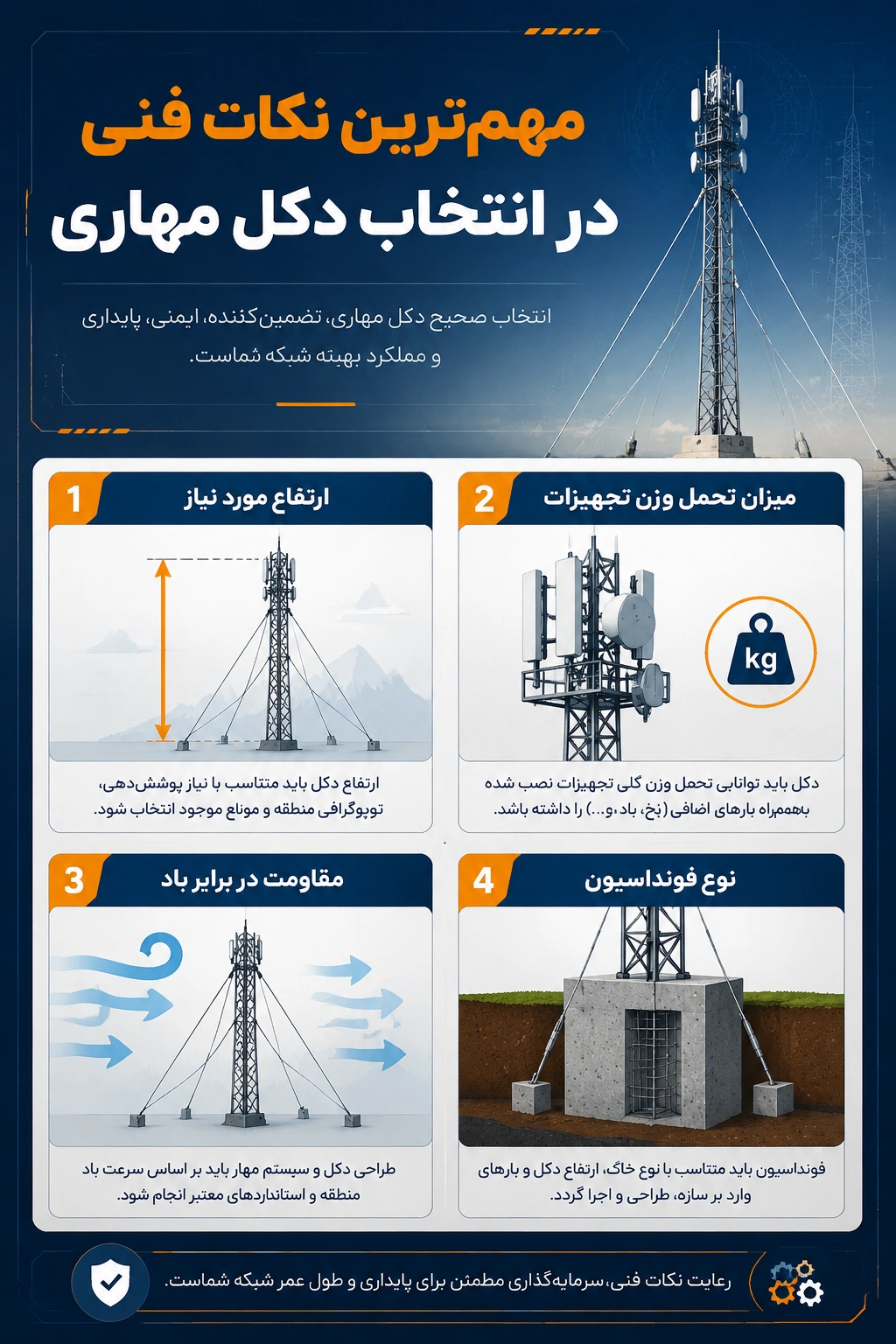
The selection of a guyed tower goes beyond height; it involves a set of technical factors that influence performance, safety, and durability. A careful review helps choose a tower that meets project needs and maintains stability under varying environmental conditions. Below are the key items to consider before selecting a guyed tower.
Required height
The primary factor is defining the appropriate height. Height should be determined based on usage, coverage area, environmental obstacles, and installation location. Choosing a height lower than needed degrades equipment performance, while excessive height increases installation, bracing, and maintenance costs. Therefore, height must be calculated precisely to meet real project needs.
Payload capacity
Each guyed tower has a specific payload capacity that must be verified before equipment installation. The weight of antennas, dishes, cables, lights, and other fixtures add to the tower's final load. If the bearing capacity is less than the total loads, stability may decrease and structural damages may rise. Hence, current and potential future equipment weights should be considered in advance.
Wind resistance
Wind load is one of the most influential factors in design. Taller towers or those with larger surface areas experience higher wind forces. In windy regions, the tower selection should follow climatic conditions and wind-load standards to prevent excessive sway and equipment damage.
Foundation type
The foundation is the core of stability and must be designed considering tower height, soil type, loads, and environmental conditions. An improperly chosen or executed foundation can compromise safe operation even for high-quality towers. Soil type, moisture, compaction, and project site all directly affect foundation design and dimensions. Site assessment before foundation work is essential.
Environmental conditions and the tower choice
Environmental factors are crucial because the tower remains outdoors for long periods and is continuously exposed to wind, rain, humidity, temperature fluctuations, and sometimes corrosive environments. Without considering environment, performance may degrade and maintenance costs rise. A thorough environmental assessment before selection is essential.
Wind resistance
Wind is a major environmental factor. In windy regions, the body of the tower and its equipment face higher pressures, necessitating a structurally capable design. Stronger bracing or more robust sections may be required in such conditions.
Humidity and precipitation
High humidity or heavy rainfall increases the risk of corrosion. In such environments, selecting towers with appropriate protective coatings or high corrosion resistance helps extend longevity and reduce maintenance costs.
Temperature and weather variation
Severe temperature changes, direct sun exposure, frost, or heat can affect joints and components. Towers in harsh climates should use materials and connections that resist thermal expansion, contraction, and wear.
Soil type and installation site
Site soil characteristics, looseness or compactness, slope, and settlement potential influence foundation and even tower type. If the site has unfavorable geological conditions, foundation design should be more careful to preserve overall stability.
Corrosive and pollutant conditions
Industrial, coastal, or contaminated areas expose structures to corrosive agents, salts, fumes, and chemical pollutants, accelerating wear. In such cases, stronger protective coating and higher construction quality become more important.
Three-leg vs four-leg towers: guidance for choosing
Choosing between three-leg (triangular) and four-leg (square) tower configurations is a key decision during procurement and installation. This choice directly affects structural resistance, installation space, load-bearing capacity, and project costs. The following summarize these configurations and relate them to common standards.
Three-leg towers
Three-leg towers have a triangular cross-section. They are lighter, occupy less space, and are well-suited for budget-conscious or space-limited projects. They attract less wind load and are quicker to install and brace. They are typically used for lighter equipment such as small wireless antennas, weather instruments, and surveillance cameras at moderate heights.
Four-leg towers
Four-leg towers have a square cross-section. With four bases and more connections, they offer higher structural stability and load-bearing capacity, and better resistance to torsional and strong wind loads. They are used in larger telecommunications projects, radio stations, and areas with harsh weather, though their construction, transport, and installation costs are higher.
Example: G35 guyed tower
The G35 tower is a widely used and standard model in the market. It typically comes in a three-leg configuration with a base width of 35 centimeters. Its light weight, easy installation, and cost-effectiveness make it a popular choice for rooftop installations on residential and commercial buildings. It is typically designed for medium heights and lighter local connectivity equipment, balancing price, performance, and ease of installation.
Summary
To select an appropriate guyed tower, a set of technical and environmental factors must be considered simultaneously, including required height, equipment weight, weather conditions, wind resistance, foundation type, and installation site. For lighter projects, three-leg towers such as the G35 are often economical and practical, while for greater heights or higher loads, four-leg towers provide a more reliable option. The right choice occurs when the tower aligns with real project needs, environmental conditions, and safety requirements.
Frequently Asked Questions
Which tower model is more suitable for rooftops?
For rooftop installations, three-leg towers are generally more suitable, especially models like the G35, due to lighter weight, smaller footprint, and suitability for light to medium equipment. Final selection should consider building structural integrity, required height, and equipment type.
What is the maximum height of a guyed tower?
The maximum height depends on tower type, manufacturing quality, number of guy wires, environmental conditions, and foundation design. Towers can range from a few meters to several tens of meters, with final height determined by technical calculations and implementation standards to ensure safety.
Is a permit required to install a guyed tower?
In many cases, installation may require permits depending on the location, tower height, application type, and local or organizational regulations. It is advisable to check applicable rules with the relevant authorities before installation, especially in urban areas and communications projects.
How resistant are guyed towers to wind?
Wind resistance varies with tower type, height, number and angle of guy wires, weight, equipment surface, and regional climate. A well-considered design and precise execution yield better wind performance, so wind-load considerations should be part of the design and selection process.
برای ارزیابی پایداری، امنیت و نگهداری این زیرساخت، راهنمای پشتیبانی شبکه را نیز مطالعه کنید.