Comparing WAN, LAN, and MAN Networks: Concepts, Uses, and Key Differences
LAN, MAN, and WAN networks differ in geographic scope and intended use. This article explains the concepts, main differences, and considerations for choosing network infrastructure.
خلاصه تخصصی مقاله
LAN, MAN, and WAN networks differ in geographic scope and intended use. This article explains the concepts, main differences, and considerations for choosing network infrastructure.
موضوعات اصلی: پشتیبانی شبکه، شبکه، LAN، WAN، MAN، شهر
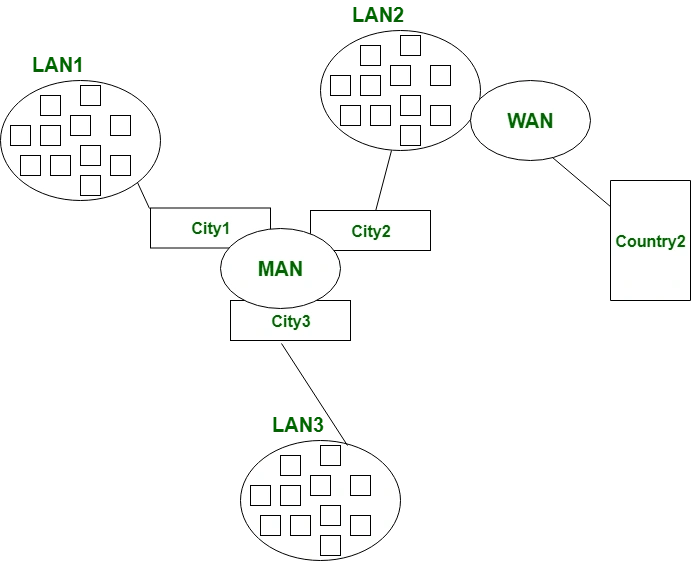
The differences among LAN, MAN, and WAN are defined by geographic scope and application. LAN (Local Area Network) is designed to connect devices in a small area such as a home, office, or building and typically offers high speeds. MAN (Metropolitan Area Network) covers a larger area at the city level and interconnects multiple LANs. WAN (Wide Area Network) is the broadest type of network, capable of linking regions as large as several cities, countries, or continents, with the Internet being the largest example.
What is a LAN?
A Local Area Network (LAN) connects multiple devices within a limited geographic area such as a house, office, school, or building. Devices like computers, laptops, printers, and servers are interconnected using network equipment such as switches, routers, copper or fiber cables, or Wi‑Fi to share data and resources at high speed. A key feature of LANs is high data transfer speed and relatively simple management within a constrained environment.
What is a MAN?
A Metropolitan Area Network (MAN) covers a footprint larger than a LAN and is typically used to connect several LANs within a city or metropolitan region. These networks are often managed by organizations, telecom providers, or city authorities and rely on high-capacity fiber optic infrastructure for fast data transmission.
What is a WAN?
A Wide Area Network (WAN) connects geographically very large areas such as multiple cities or countries and employs various technologies including fiber optic links, wireless links, and satellites. The Internet is the most well-known example of a WAN.
LAN, MAN, and WAN differences
Networking types are categorized by geographic scope and usage. LAN is suited for small environments with high speeds, MAN connects several networks within a city, and WAN enables interconnection across broader regions. The following table compares some key characteristics of these networks.
| Feature | LAN | MAN | WAN |
|---|---|---|---|
| Full name | Local Area Network | Metropolitan Area Network | Wide Area Network |
| Coverage | Small area such as a building or campus | City or metropolitan region | Very large, spanning multiple cities or countries |
| Ownership | Typically private | Can be private or public | Often owned by several organizations or carriers |
| Data speed | High | Medium to high | Typically lower than LAN and MAN |
| Delay | Low | Medium | Higher |
| Traffic | Low | Higher than LAN | Higher than MAN |
| Design and maintenance | Relatively simple | More complex than LAN | More complex and costlier |
| Applications | Internal networks for homes, offices, schools | Interconnecting networks within a city | Interconnecting networks across countries and the Internet |
The LAN, MAN, and WAN network types connect devices across different geographic scopes and are commonly used to enable various forms of connectivity. LAN is suited for small-scale environments, MAN links multiple LANs within a city, and WAN provides large-scale interconnection, often including the Internet.
Conclusion
In summary, LAN, MAN, and WAN are designed to cover different scales of connectivity. LAN serves small environments with high speeds and lower costs, MAN connects multiple networks within a city, and WAN enables inter-networking over wider regions. The choice of network type depends on geographic scope, organizational needs, required speed, and deployment cost.
Frequently Asked Questions
What is the main difference between LAN and WAN?
The primary difference is geographic scope. LAN is used in a small environment, while WAN connects much larger regions.
Is the Internet a WAN?
Yes, the Internet is the largest example of a WAN, connecting millions of networks worldwide.
Where is MAN used?
MAN is typically used to connect several local networks within a city, such as linking universities, government agencies, or various company locations across the city.
Which network is faster?
Generally, LAN is faster than MAN and WAN because it covers a smaller area and data travels shorter distances.
Can LAN work without Internet?
Yes, a LAN can operate without Internet, and devices can still share files, printers, and other resources.
Which network has higher deployment costs?
WAN deployment typically incurs higher costs due to the need for broader infrastructure, more equipment, and more complex communication technologies.
برای ارزیابی پایداری، امنیت و نگهداری این زیرساخت، راهنمای پشتیبانی شبکه را نیز مطالعه کنید.