What is a Wide Area Network (WAN)? How It Works and Uses
A Wide Area Network (WAN) connects offices, data centers, and resources across large distances, enabling scalable and borderless data transfer. This article reviews WAN fundamentals, its operation, and common applications.
خلاصه تخصصی مقاله
A Wide Area Network (WAN) connects offices, data centers, and resources across large distances, enabling scalable and borderless data transfer. This article reviews WAN fundamentals, its operation, and common applications.
موضوعات اصلی: WAN، data، can، offices، across، Networks
Wide Area Networks (WANs) enable businesses and organizations to connect offices, data centers, and various resources, allowing data to move across large scales beyond geographic boundaries.
From connecting global offices to sharing critical resources, WAN has become the backbone of modern communications. This article reviews WAN fundamentals, how it works, and common applications.
Introduction to WAN
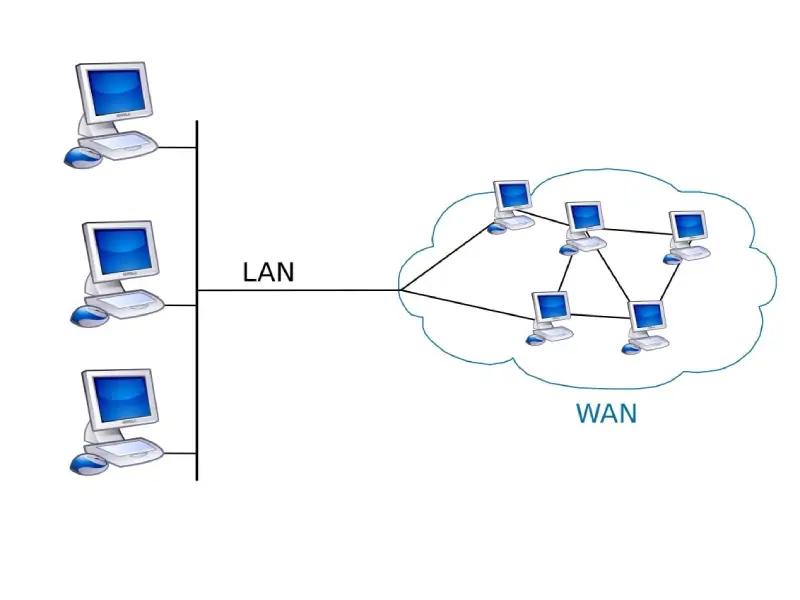
A WAN is a computer network that connects smaller networks such as LANs and enables long-distance communication. Unlike local networks confined to a single building or location, WANs can cover wide areas such as cities, countries, or the world.
One major use is connecting offices and branches of an organization. Each office typically has its own LAN that connects to others through a common WAN. This enables data sharing, faster communications, and coordinated IT resources across locations.
Technically, any network that spans a wide geographic area can be considered a WAN. For example, the Internet is the largest and most well-known WAN, linking billions of devices and networks around the world. WANs can be deployed over leased lines, fiber, satellites, radio links, and even wireless connections.
The main goal of WAN is to provide stable and fast connectivity between local networks across geographic distances so that users can access data and resources regardless of distance.
How WAN Works
WAN connects local networks across regions, enabling data transfer at scale. It typically relies on devices such as routers, switches, fiber links, satellites, and radio waves to carry data between distant points.
In operation, data from a device is sent to a router and traverses through network infrastructures (leased lines, MPLS, or the public Internet) to the destination. Along the way, data is routed by routers and may be encrypted or compressed as needed. At the destination, data is reassembled and presented to the user.
History of WAN
The first WAN emerged in the late 1950s by the U.S. Air Force for the SAGE radar defense system, using telephone lines and dedicated modems.
Subsequently, WANs expanded to connect offices to data centers. Early designs featured point-to-point connections between offices and central systems, often implemented as client/server or peer-to-peer.
A major milestone was ARPANET in the 1960s, which laid the foundations for the modern Internet. Finally, the introduction of packet-switching and TCP/IP improved data management and security in WANs, enabling the global Internet's growth.
WAN Types
Organizations use different WAN connections to link offices, data centers, and cloud infrastructures. Due to cost and equipment needs, WAN infrastructures are typically leased from service providers. Here are the main types:
- Leased Lines: a dedicated line from an Internet Service Provider that connects two LANs directly. This approach offers high reliability and security but can be costly.
- Tunneling (VPN): data is transmitted encrypted over the public Internet to the destination. The most common example is VPN.
- MPLS: Multi-Protocol Label Switching routes traffic by labels rather than IP addresses, delivering faster and more efficient network performance. MPLS can be combined with frame relay, Ethernet, etc.
- SD-WAN: Software-Defined WAN controls and manages traffic in software and can use broadband Internet to reduce costs. It is flexible and aligns with cloud-based infrastructures.
WAN Architecture
WAN architecture is based on the Open Systems Interconnection (OSI) model, which has seven layers. Various network technologies operate at different OSI layers to form a large, efficient network, enabling optimized data management and long-distance connectivity.
Common WAN Applications
WANs are used across industries due to their ability to connect devices and networks over long distances. Here are some key uses:
1. Enterprise data sharing at scale
Large organizations use WAN to share information between offices, branches, and teams. For example, central office managers can store documents and databases on a central server for access by regional offices.
2. Secure and protected communications
In sensitive sectors such as defense and security, WANs enable secure, encrypted communications protected from cyber threats.
3. Online reservations and purchases
Industries like transportation, rail, and airlines use WAN for reservation systems so customers can connect to central servers to book tickets and complete payments.
4. Inter-organizational data sharing
Universities and research centers use WAN to share research data and important notices, and to enable online seminars and conferences.
5. Local workstation connectivity without Internet
Some organizations use WAN to connect local workstations without requiring Internet connectivity, maintaining internal device communication.
6. Sharing hardware resources
WAN enables sharing hardware such as printers, servers, and storage across offices. For example, a multinational company can print a document from the head office to a printer in a foreign branch.
WAN Advantages
WAN offers wide coverage and the ability to connect devices from different locations, with various advantages and trade-offs. Here are some key benefits:
Geographic coverage
WAN links offices and branches across long distances, suitable for international businesses.
Support for diverse devices
WAN can connect a wide range of devices so users can access resources from any place and device.
Wireless connectivity
Some WANs provide wireless access via radio signals and device-integrated receivers, enabling wireless connections.
Shared software and hardware resources
WAN enables access to software and resources within an organization or across multiple organizations, including remote access to printers and data servers.
Wide-scale information sharing
WAN facilitates sharing information and files across a broad scale, especially for remote collaboration.
WAN Disadvantages
Disadvantages include high initial setup costs, management complexity, longer fault resolution times, and relatively lower security compared to LAN. VPN and encryption can help enhance security.
WAN Protocols
WAN protocols are a set of rules used to establish communication and data transfer in these networks. Here are the main WAN protocols:
- Frame Relay: an older technology that segments data into independent frames and transmits them over dedicated lines between points; operates at OSI layers 1 and 2.
- ATM (Asynchronous Transfer Mode): data is divided into 53-byte cells and transmitted using TDM; cells are reassembled at the destination.
- SONET/SDH: a protocol for data transport over optical fiber, enabling high-speed, point-to-point connections.
- TCP/IP: core protocols for packaging, addressing, transmitting, and receiving data in WAN. The IPv6 version offers improved security and efficiency.
Conclusion: A connected and borderless future with WAN
As technology advances with SD-WAN and MPLS, WANs become more efficient and flexible, opening new paths for sharing data and resources among organizations. For businesses seeking professional WAN solutions, consulting with qualified network providers can help enhance their connectivity infrastructure.
برای ارزیابی پایداری، امنیت و نگهداری این زیرساخت، راهنمای پشتیبانی شبکه را نیز مطالعه کنید.