Key Differences Between LAN and WAN Networks
This article explains the essential differences between LAN and WAN and provides guidance for choosing and designing networks for organizations or projects.
خلاصه تخصصی مقاله
This article explains the essential differences between LAN and WAN and provides guidance for choosing and designing networks for organizations or projects.
موضوعات اصلی: WAN، LAN، differences، between، can، Local
The growth of connectivity and reliance on technology has made computer networks an essential part of daily life and business. When discussing networks, two main types attract the most attention: LANs and WANs. Each has its own characteristics and use cases, and the choice between them can significantly affect performance and cost depending on the environment.
Below we explore the essential differences between these networks to help you make a better decision for your organization or project.
Introduction to LAN
A Local Area Network LAN connects devices and computers within a limited geographic area such as a home, school, laboratory, or office building, enabling resource sharing such as files, printers, and applications. LANs are designed to provide fast local connectivity and resource sharing.
What is WAN
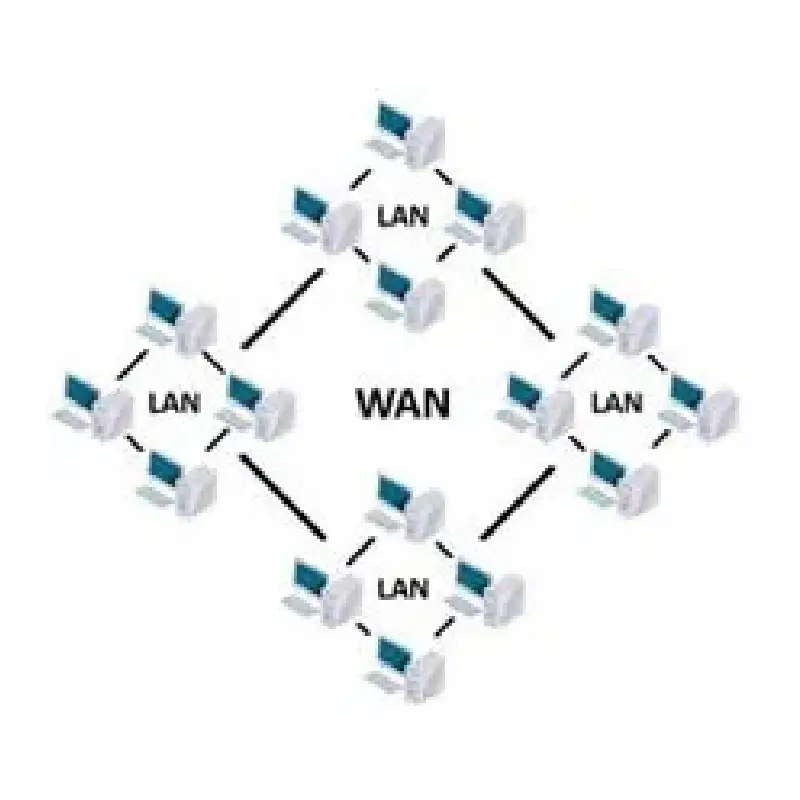
Wide Area Network WAN covers a broader geographic area than LAN and is used to connect systems and devices over long distances. Connections can be made via telecommunications lines or other technologies. WANs are typically used by organizations that need to link multiple branches or offices in different locations, enabling communication between LANs over large distances.
LAN applications
Common LAN applications include:
- Designating a server for resource management
- Storing software on a central server and providing access to all network users
- Connecting workstations in a building for local communication without Internet
- Sharing resources such as printers and scanners
- Centralized management and sharing of development and testing tools in offices
WAN applications
Key WAN applications include:
- Sharing data between departments to facilitate collaboration
- Connecting branches and offices in different locations
- Secure communication for sensitive operations
- Sharing data and resources among institutions and universities using WANs
- Connecting workstations in distant locations for local communication without Internet
LAN advantages
LAN offers several advantages including:
- Resource sharing such as central storage and printers
- Centralized data management on a server with easy access for users
- Simple data and message transfer between computers
- Efficient Internet or resource sharing at the network level
WAN advantages
WAN provides important advantages including:
- Extensive geographic coverage enabling connections between offices and centers far apart
- Support for a variety of devices and wireless connectivity via different technologies
- Sharing resources and software among multiple workstations
- Access to data and services over long distances
Disadvantages of LAN
LAN has drawbacks such as:
- Initial cost for setup and equipment
- Need for continuous management for security and performance
- Potential privacy concerns if proper controls are not in place
Disadvantages of WAN
WAN also has drawbacks such as:
- High initial installation costs and significant investment
- Maintenance complexity requiring skilled technicians
- Time-consuming problem diagnosis and resolution
- Generally lower security compared to LAN
Key differences between LAN and WAN
We now outline the key differences between LAN and WAN.
Differences in definition and geographic scope
A LAN is a local network deployed within a small area such as a home or office, typically operating over short distances between devices. A WAN is formed by interconnected networks that cover a wide geographic area and often requires dedicated communication lines or leased networks. WAN is used to connect offices of a company in different locations.
Differences in speed and data transfer rates
LAN generally provides higher data transfer speeds and can reach 1000 Mbps or more depending on proximity and cabling quality. WAN typically offers lower speeds and can reach up to around 150 Mbps due to longer distances and use of public or leased lines.
Differences in latency
Latency in LAN is low since connections are local. In WAN, latency is higher due to longer distances and varied infrastructure, which can impact performance for data-heavy transactions.
Differences in ownership and access
LAN is usually owned by an individual or organization and is private. WAN can be private or public; the Internet is the largest public WAN and requires stronger security measures to prevent unauthorized access.
Differences in cost and deployment complexity
LAN deployment is generally simpler and cheaper due to its small scope and basic equipment. WAN deployment is more costly due to wider coverage and telecommunications infrastructure and requires skilled technicians for maintenance.
Differences in fault tolerance and reliability
LAN typically offers higher fault tolerance and faster repairs due to local scope. WAN, due to its breadth and diverse technologies, often has lower fault tolerance and longer repair times.
Differences in scalability and expansion
Adding devices in a LAN is usually straightforward and cheaper. Expanding a WAN can be complex and costly, though using public lines can reduce costs. Ultimately both LAN and WAN have trade-offs; the choice depends on organizational needs. LAN suits small, high-speed environments; WAN suits long-distance connectivity among offices.
For designing and implementing a quality network, professional consultation can help tailor a solution to your needs.
برای ارزیابی پایداری، امنیت و نگهداری این زیرساخت، راهنمای پشتیبانی شبکه را نیز مطالعه کنید.