What is a WAN (Wide Area Network) and how does it work? Functionality, architecture, and applications
This article explains the concept of WAN, how it operates, its history, types, architecture, and common uses, along with protocols and future directions.
خلاصه تخصصی مقاله
This article explains the concept of WAN, how it operates, its history, types, architecture, and common uses, along with protocols and future directions.
موضوعات اصلی: WAN، data، can، Internet، offices، connectivity
A WAN, or Wide Area Network, is a network that connects offices, data centers, and resources over large geographic areas to transmit data over an extensive footprint. Such networks enable communication across long distances and can cover global scale. Common uses include connecting offices worldwide and sharing critical resources.
What is WAN
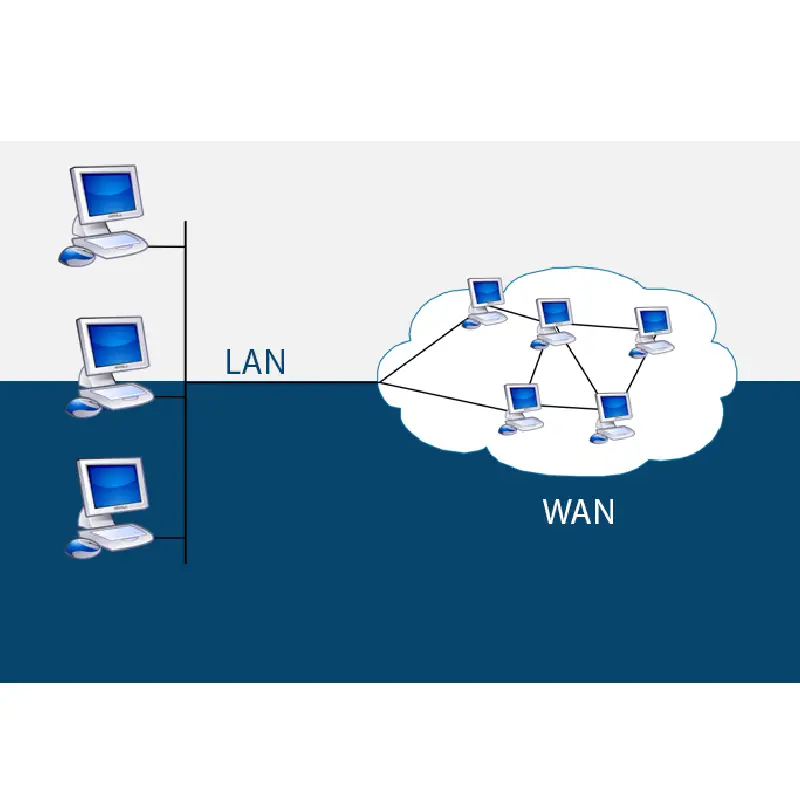
A WAN links local area networks (LANs) to enable communication across long distances, unlike LANs which are confined to a local area; WAN can cover cities, countries, or the world.
A key application of WAN is connecting an organization’s offices and branches. Each office typically has its own LAN, which is connected to others through a WAN to share data and coordinate IT resources across locations.
Technically, any network that spans a broad geographic area can be considered a WAN. For example, the Internet is the largest and most well-known WAN, linking billions of devices and networks globally. WANs can be built over leased lines, fiber, satellite, radio links, and wireless connections.
The primary goal of WAN is to provide stable and fast connectivity between local networks at different locations, enabling users to access data and resources regardless of distance.
How WAN works
A WAN connects LANs across regions to enable data transfer at scale. It typically uses equipment such as routers, switches, fiber links, satellites, and radio transmissions to move data between distant points.
Data travels from a device (for example, a user’s computer) to a router and then through various network infrastructures (leased lines, MPLS, or the public Internet) to the destination. Along the way, data may be encrypted or compressed. At the destination, data is reassembled and presented to the user.
History of WANs
The first WAN was developed in the late 1950s by the U.S. Air Force for the SAGE radar defense system, using telephone lines and dedicated modems. WANs later expanded to connect offices to data centers, with point-to-point connections between offices and central systems in client/server or peer-to-peer architectures.
A major evolution occurred with the advent of ARPANET in the 1960s, which is considered a precursor to the modern Internet. Ultimately, packet switching and TCP/IP protocols were introduced, enabling better data management and security and paving the way for the global Internet.
Types of WAN
Organizations use various WAN connectivity types to link offices, data centers, and cloud infrastructures. Due to high costs and the need for advanced equipment, networks are often leased from Internet service providers. Key WAN types include:
- Leased-line WAN: a dedicated circuit leased from an ISP, directly connecting two networks. It offers high reliability and security but at a higher cost.
- Tunneling-based WAN: data is transmitted securely over the public Internet via encrypted tunnels. VPN is a common example.
- MPLS-based WAN: uses labels for routing rather than IP addresses, improving speed and efficiency. MPLS can be combined with frame relay, ATM, and Ethernet.
- SD-WAN: Software-Defined WAN, where traffic management is performed in software and broadband Internet can reduce costs. It offers high flexibility and aligns with cloud infrastructures.
WAN architecture
WAN architecture is designed around the OSI model, which has seven layers. Different networking technologies operate on various layers to form a wide and efficient network, enabling optimized data management and long-distance connectivity between systems.
Common WAN applications
WANs enable long-distance connectivity across industries. Examples include:
1. Enterprise data sharing at scale
Organizations share documents, databases, and essential files across offices and teams via centralized servers accessible from regional sites.
2. Secure and intrusion-resistant communications
In sensitive domains such as security and defense, WANs provide encrypted, protected networks to minimize intrusions.
3. Online booking and purchasing systems
Transportation, rail, and aviation sectors use WANs for booking and online payments, enabling customers to access centralized servers from anywhere.
4. Inter-organizational data sharing
Universities and research centers use WANs to share student and research data and to host online events and seminars.
5. Local workstation connectivity without direct Internet access
Some organizations use WAN to connect local workstations without requiring direct Internet access, enabling internal communication.
6. Sharing hardware and software resources
WAN enables centralized access to printers, servers, and storage, and can facilitate printing from the head office to remote branch printers.
WAN is a powerful technology for long-distance communication and data exchange, playing a key role in business, education, defense, and industry.
WAN advantages
WAN offers broad geographic coverage and cross-location connectivity, with advantages such as:
Geographic coverage
Connects offices across long distances, benefiting international and multi-branch organizations.
Device compatibility
Can connect a wide range of devices including PCs, laptops, and tablets.
Wireless connectivity
Some WAN connections support wireless access via radio links.
Shared software and hardware resources
Enables access to shared applications and peripherals such as printers and servers.
Scalable information sharing
Facilitates remote collaboration by sharing data across the organization.
WAN drawbacks
Potential drawbacks include high initial setup costs, management complexity, and longer time to troubleshoot due to the mix of technologies. Security can be lower than LAN, though employing VPNs and encryption mitigates this risk.
WAN protocols
WAN protocols define rules for connectivity and data transfer. Key protocols include:
- Frame Relay
- ATM (53-byte cells)
- SONET/SDH
- TCP/IP with IPv6
Future: a connected and borderless WAN
Modern WANs leverage technologies like SD-WAN and MPLS to provide fast, secure connections between offices, while evolving toward greater flexibility and efficiency. Organizations seeking professional WAN solutions can benefit from structured design, deployment, and ongoing support to elevate their infrastructure.
برای ارزیابی پایداری، امنیت و نگهداری این زیرساخت، راهنمای پشتیبانی شبکه را نیز مطالعه کنید.