How to Prevent CCTV Hacking? Essential Security Settings
This article explains why CCTV cameras are vulnerable to hacking and outlines essential security settings to prevent unauthorized access.
خلاصه تخصصی مقاله
This article explains why CCTV cameras are vulnerable to hacking and outlines essential security settings to prevent unauthorized access.
موضوعات اصلی: security، CCTV، access، can، settings، secure
Introduction
With the expansion of surveillance systems, the security of CCTV imagery has become more important than ever. Many users believe that merely installing cameras guarantees security, but without implementing security principles, these devices can become a vulnerability. Hackers can gain access through default passwords or misconfigurations, view or even publish sensitive footage. This threat endangers privacy and poses security risks for homes, businesses, and organizations. Here we examine why cameras are vulnerable and which security settings must be implemented to reduce intrusions.
Why are CCTV cameras vulnerable?
CCTV cameras, especially networked models, connect to the internet or an organizational network. If secured improperly, this connection provides an easy path for attackers. The main vulnerabilities are:
- 1. Use of default factory passwords
- 2. Remote access without secure configurations
- 3. Not updating firmware
- 4. Directly connecting cameras to the public internet
- 5. Lack of network segmentation (VLAN or Subnet)
Essential security settings to prevent CCTV hacking
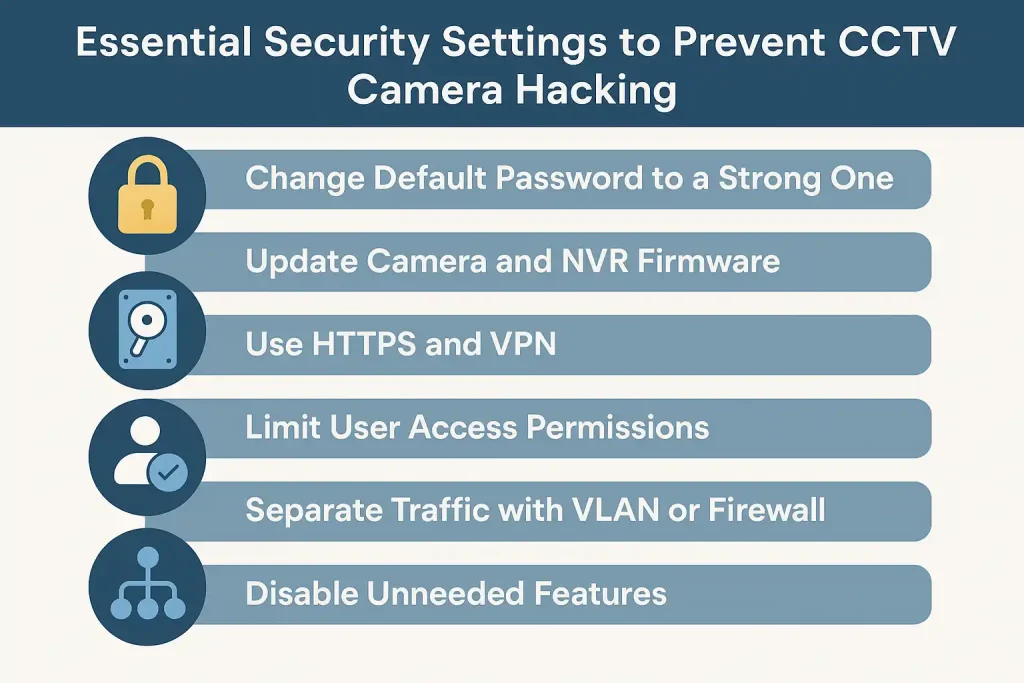
To ensure security after installation, implement the following settings:
- 1. Change default passwords and choose strong passwords
- 2. Regularly update camera and NVR firmware
- 3. Use secure protocols (HTTPS and VPN)
- 4. Restrict user access
- 5. Isolate camera traffic with VLAN or firewall
- 6. Disable unnecessary features
Additional security measures
To strengthen security you can use:
| Action | Description | Main Benefit |
|---|---|---|
| Enable activity logs and periodic review | Log and monitor logins, settings changes, and access | Rapid detection of suspicious activity and prevention of intrusions |
| Use reputable cloud services | Store and access footage in the cloud with encryption | Improved security against local data theft or loss |
| Disable unnecessary access (like UPnP) | Disable extra features and insecure ports | Reduced attack surface and prevention of misuse |
Quote from a security expert
Most cyber attacks on CCTV occur due to simple configurations and neglecting basic security principles. Enabling logs, using secure cloud services, and restricting access can substantially mitigate threats.
Specialist tips for CCTV installers
Installers play a key role in ensuring the security of surveillance systems. Following points help reduce vulnerabilities:
Importance of using secure PoE switches
- Always use reputable PoE switches with built‑in security features.
- Avoid cheap, unnamed switches lacking security features.
- Check PoE power management to prevent voltage drops or instability.
Monitoring camera traffic with IDS/IPS
- In organizational networks, camera traffic should be monitored by intrusion detection and prevention systems.
- This helps quickly identify brute-force attacks, port scans, or abnormal traffic.
- Even in small environments, using a firewall with IDS/IPS capabilities adds value.
End-user training for security best practices
- Users should be educated on changing passwords, updates, and secure access.
- Documenting configurations and providing simple user guides adds value for customers.
Conclusion
Security in surveillance systems depends not only on hardware quality but also on proper configuration and adherence to security principles. Home environments can improve security with simple steps, while organizational settings require advanced measures such as network segmentation, secure protocols, and traffic monitoring. The CCTV installer plays a vital role in preventing many threats from the outset by proper configuration and user training.
How can I tell if my CCTV has been hacked?
Signs include changes to settings without your knowledge, unexpected LED on/off, increased Internet usage, and unfamiliar logins to the management panel.
Is changing the default password enough?
Changing the password is the first step but not sufficient. Firmware updates, restricting access, and using a VPN are also essential.
What is the best way to securely access remote CCTV footage?
Using a secure VPN is the best method. Access should occur through an encrypted tunnel rather than direct port forwarding.
Are all CCTV cameras at risk?
Yes; any camera connected to a network or the Internet can be targeted. The level of risk depends on security settings and brand quality.
What is the role of the CCTV installer in increasing security?
A professional installer can reduce threats from the outset by proper configuration, network segmentation, and user education.
Conclusion
Security in surveillance systems hinges on more than hardware; proper configuration, regular updates, and access control are crucial. Home environments can be secured with simple steps, while organizational contexts require advanced measures. Always entrust installation and support to specialized teams to protect privacy and ensure performance.
برای ارزیابی پایداری، امنیت و نگهداری این زیرساخت، راهنمای پشتیبانی شبکه را نیز مطالعه کنید.