What are Self-Healing Networks and How Does AI Make Networks More Resilient?
An overview of Self-Healing Networks, how they operate with AI and ML, their benefits, practical applications, and considerations for organizations of different sizes.
خلاصه تخصصی مقاله
An overview of Self-Healing Networks, how they operate with AI and ML, their benefits, practical applications, and considerations for organizations of different sizes.
موضوعات اصلی: پشتیبانی شبکه، Self-Healing، Networks، network، human، data
Introduction
Enterprise network management has always faced challenges such as outages, performance degradation, and human error. Every minute of downtime can cause significant damage and undermine business credibility. IT leaders seek a solution that can identify, predict, and even automatically fix network problems without continuous human intervention. This is where the concept of Self-Healing Networks comes in.
These networks monitor device status and traffic in real time using AI and machine learning, and when disruptions occur, they can act to resolve issues without administrator involvement. Such capabilities make networks more resilient, secure, and cost-efficient.
In this article, we explain in plain language what Self-Healing Networks are, how they work, and the benefits they bring to organizations. If you are looking for more resources or guidance, you can explore practical implementation strategies for this technology.
What is a Self-Healing Network?
Traditional networks are typically designed so that problem resolution requires direct intervention by a network administrator or support team. This intervention may involve manual troubleshooting, resetting devices, changing configurations, or replacing hardware. The consequence is increased downtime, wasted resources, and pressure on IT teams.
Self-Healing Networks take a different approach. They leverage AI and machine learning to continuously monitor the status of equipment and traffic, respond automatically to disruptions, and learn from past events to improve future responses. In simple terms, a self-healing network acts like a digital physician for your infrastructure: it detects issues, remedies them, and saves its lessons to prevent recurrence.
According to Gartner, “Self-Healing Networks can automatically resolve up to 80% of common configuration- or human-error–related faults, increasing organizational resilience.”
How Self-Healing Networks Work
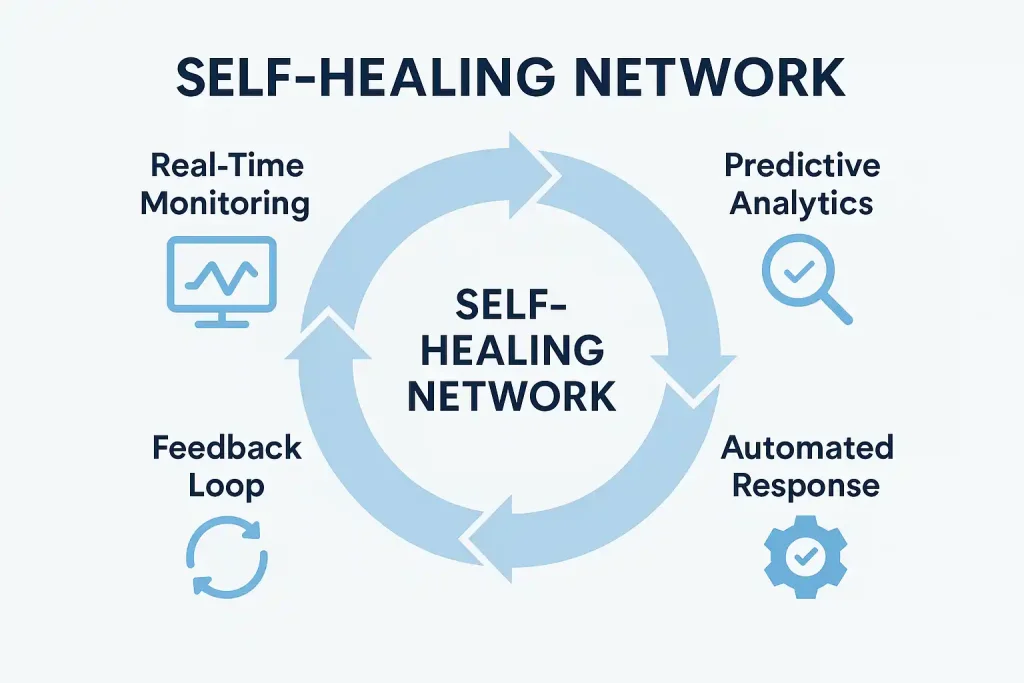
Self-Healing Networks are more than an advanced monitoring tool; they incorporate mechanisms to predict, detect, and fix problems. The typical workflow is summarized in four main stages:
- Real-Time Monitoring – continuously monitors traffic, latency, packet loss, and equipment health.
- Predictive Analytics – analyzes collected data with ML to identify anomalous patterns.
- Automated Response – responds automatically to incidents without human intervention.
- Feedback Loop – learns from each event to improve future performance.
Think of a self-healing network as a digital physician for your IT infrastructure: it detects problems, cures them, and stores its experiences to prevent recurrence.
Benefits of Self-Healing Networks
- Reduced Downtime and Increased Availability – problems are detected and resolved quickly without waiting for human intervention.
- Less Human Intervention – fewer human errors in configuration and handling of issues.
- Optimized Resources and Bandwidth – continuous monitoring directs traffic along optimal paths, improving efficiency.
- Lower Networking Support Costs – IT teams can focus on strategic initiatives.
- Enhanced Security – automatic threat detection and mitigation reduce exposure to attacks.
Practical Applications of Self-Healing Networks
| Application Area | Description | Key Benefits |
|---|---|---|
| Organizational Data Centers | Data centers house thousands of servers and switches; a small outage can escalate quickly. | Lower Downtime, improved infrastructure performance, rapid fault response |
| Cloud Infrastructure | In cloud environments like AWS and Azure, Self-Healing helps restore VMs and services automatically without manual intervention. | Greater scalability, service continuity, reduced support costs |
| 5G and IoT Networks | Massive numbers of devices require continuous monitoring; Self-Healing swiftly identifies and fixes issues. | Improved service quality, intelligent traffic management, fewer disruptions |
| Distributed Remote Work Environments | Remote workers require stable and secure connections; Self-Healing can automatically recover VPN or remote access services after disruptions. | Increased employee productivity, fewer support calls, enhanced security |
Future of Self-Healing Networks
The future of self-healing networks is tightly linked with advances in AI and deep learning. Smart algorithms will not only identify current faults but also predict and prevent disruptions before they occur. Integrating Self-Healing with modern security architectures such as SASE and Zero Trust will advance both resilience and security. Major tech vendors are already investing heavily in this area, signaling that Self-Healing Networks will soon become a core part of enterprise infrastructure.
Self-Healing Networks vs. Traditional Network Monitoring
| Comparison Criterion | Traditional Network Monitoring | Self-Healing Networks |
|---|---|---|
| Approach | Reactive – alerts after an issue occurs | Proactive and autonomous – prevention and auto-remediation |
| Problem Detection | Alerts and fixed thresholds | AI/ML-based anomaly detection and pattern analysis |
| Human Intervention | High – manual fault finding and action | Minimal – automated actions with human oversight |
| Response Speed | Slower; depends on IT availability | Very fast – near real-time |
| Predictive Capabilities | Poor or absent | Present (Predictive Analytics) |
| Downtime Reduction | Limited | Significant |
| Impact on Human Error | Common | Reduced substantially |
| Learning from Incidents | None | Yes (Feedback Loop, continuous improvement) |
| Implementation Complexity | Low to Medium | High (requires design and high-quality data) |
| Initial Cost | Lower | Higher |
| Long-Term Cost (TCO) | Typically higher due to downtime and headcount | Lower at scale (medium to large) |
| Best Fit | Small and simple networks | Medium to large organizations, enterprises, and data centers |
| Scalability | Limited | Very high |
| Automation Level | Low | High and intelligent |
| Risks | Human dependency | False positives, automation loops, vendor lock-in |
Are Self-Healing Networks Suitable for All Organizations?
The short answer is no; but for some organizations they provide a critical competitive advantage. The decision to adopt Self-Healing Networks should be based on network size, service sensitivity, and the IT team's maturity, not solely on technological appeal.
We examine this topic through scenarios to aid decision-making.
Small Networks (Less than 50 users) → Usually Overkill
In small organizations or offices with limited users:
- Network structure is simple
- Downtime typically has limited catastrophic impact
- Implementation cost and complexity of Self-Healing may not be justifiable
In this scenario, simple monitoring tools plus rapid manual responses are usually sufficient. Self-Healing Networks may be too complex and costly.
Bottom line: For small networks, Self-Healing is often a luxury or unnecessary.
Medium Organizations → Hybrid Approach Is Best
In medium-sized organizations:
- The user and service footprint is growing
- Disruptions can significantly reduce productivity
- The IT team is typically lean but highly skilled
In these conditions, using Self-Healing selectively (e.g., core network, critical links or sensitive services) is very logical.
Examples
- Automatic bottleneck detection in traffic
- Automatic link rerouting during outages
- Auto-restarting critical services without human involvement
Bottom line: The Hybrid model balances cost, human control, and intelligent automation.
Enterprises and Data Centers → Highly Recommended
In large networks, data centers, and enterprises:
- Downtime causes direct financial and reputational damage
- Scale of equipment, traffic, and logs exceeds human manageability
- SLAs and availability are critical
At this level, Self-Healing Networks are not optional but an operational necessity. The network should be able to:
- Predict faults before they occur
- Respond without human intervention
- Learn from every incident to improve future resilience
Challenges and Limitations of Self-Healing Networks
False Positives in AI Algorithms
Self-Healing systems depend heavily on ML models. If these models are poorly trained or inputs are incomplete, normal network behavior may be misclassified as faults.
Consequences
- Unnecessary changes in routing or QoS
- Restarting healthy services
- Instability instead of increased reliability
Therefore, tuning thresholds and human oversight in early stages are essential.
Dependence on Data Quality
Self-Healing networks are only as smart as the data they receive. Incomplete, noisy, or non-uniform data can lead to incorrect decisions.
Common challenges
- Incomplete or incompatible logs from different devices
- Limited visibility across the entire network
- Delays in real-time data collection
Without high-quality data, even the most advanced AI algorithms may err.
Automation Loop (Malicious Auto-Loop) Risks
A serious risk is the creation of faulty automated loops, where one corrective action triggers another problem, leading to a loop of reactions.
Examples
- Automatic traffic-path changes increasing load on another link
- Misidentifying congestion leading to tighter controls
- Propagation of disruption in a chain reaction
To prevent this, it is essential to define policies and limit automation capabilities.
Vendor and Platform Lock-in
Many Self-Healing solutions are deeply integrated with vendor ecosystems
- Cisco (DNA Center)
- Juniper (Apstra / Mist AI)
- Cloud platforms like AWS and Azure
This can reduce vendor flexibility, raise long-term costs, and constrain capabilities to specific equipment. Architectural design should address these dependencies clearly from the outset.
Operational Maturity and Skilled Workforce
Self-Healing Networks do not replace human expertise. Mis‑implementation without a skilled team can raise risk.
Requirements
- Deep understanding of network architecture
- Ability to interpret AI outputs
- Manual intervention capability in critical situations
Organizations still wrestling with basic network management may not be ready for full Self-Healing yet.
Conclusion
Self-Healing Networks address a major challenge for network managers: reducing downtime and increasing resilience. The combination of real-time monitoring, intelligent data analysis, and automatic fault response enables issues to be identified and resolved before they impact business. While implementing this technology requires investment and expertise, benefits such as lower support costs, resource optimization, and enhanced security suggest that future network management will be inseparable from Self-Healing capabilities. Organizations pursuing global competitiveness should start designing and implementing such infrastructures now.
1. Self-Healing Networks دقیقاً چه تفاوتی با شبکههای سنتی دارد؟
در شبکههای سنتی رفع مشکل نیازمند مداخله دستی است، اما Self-Healing Networks میتواند مشکلات را بهطور خودکار شناسایی و برطرف کند.
2. آیا این فناوری میتواند جایگزین تیم پشتیبانی شبکه شود؟
خیر. این فناوری مکمل تیمهای IT است و بار عملیاتی را کاهش میدهد، اما همچنان به متخصصانی برای طراحی، مدیریت و کنترل نیاز دارد.
3. هزینه پیادهسازی Self-Healing Networks چقدر است؟
هزینه به مقیاس شبکه و ابزارهای بهکاررفته بستگی دارد، اما در بلندمدت با کاهش Downtime و هزینههای پشتیبانی جبران میشود.
4. آیا Self-Healing Networks فقط روی تجهیزات جدید قابل اجراست؟
بیشتر راهکارها روی تجهیزات مدرن پیادهسازی میشوند، اما برخی شرکتها ابزارهایی ارائه میدهند که امکان ارتقاء شبکههای قدیمیتر را هم فراهم میکنند.