How Network Virtualization Can Help Reduce Organizational Costs
Network virtualization optimizes resources, reduces hardware needs, and lowers operating costs. This article examines key methods of deployment and their impact on infrastructure management and network security.
خلاصه تخصصی مقاله
Network virtualization optimizes resources, reduces hardware needs, and lowers operating costs. This article examines key methods of deployment and their impact on infrastructure management and network security.
موضوعات اصلی: servers، physical، Reducing، virtualization، costs، maintenance
Reducing the need for physical hardware
Network virtualization is a key technology in IT that helps improve efficiency and reduce organizational costs. By consolidating services and network resources onto one or more hosts, it enables centralized management, better scalability, and energy savings.
In recent years, network virtualization has become a core pillar in optimizing IT infrastructure. By reducing hardware requirements and improving resource management and reliability, it lowers operational costs.
1. Efficient use of servers
In traditional setups, many servers operate below capacity. Virtualization allows multiple virtual machines (VMs) to run on a single physical server. These VMs operate independently and share server resources, leading to higher utilization and reduced need for new servers.
2. Load Balancing
Network virtualization enables automated distribution of workloads across multiple virtual servers. This improves performance and resilience while preventing premature hardware wear.
3. Downtime reduction
With virtualization, VMs can be moved rapidly as needed, updates and maintenance can be performed without system outages, and network downtime is minimized, boosting productivity and reducing related costs.
4. Reducing purchase and maintenance costs
Organizations can reduce the number of physical servers required, as a single physical server can host multiple services and applications. This lowers the cost of new servers and reduces maintenance, repair, and hardware upgrade expenses. Fewer physical servers also reduce data center footprint and related infrastructure costs.
5. Process automation
Virtualization platforms offer automation for many tasks, such as backups, updates, and VM migrations. Automating these processes reduces human intervention and errors, cutting operational costs and increasing productivity.
6. Reducing energy consumption
Fewer physical servers and optimized resource use lead to lower energy use and related costs, while also reducing environmental impact.
7. Simplified management and maintenance
Network virtualization not only reduces the number of physical servers but also simplifies management and maintenance. Centralized management tools allow overseeing all virtual machines and physical servers from a single interface, reducing time and effort and lowering operational costs.
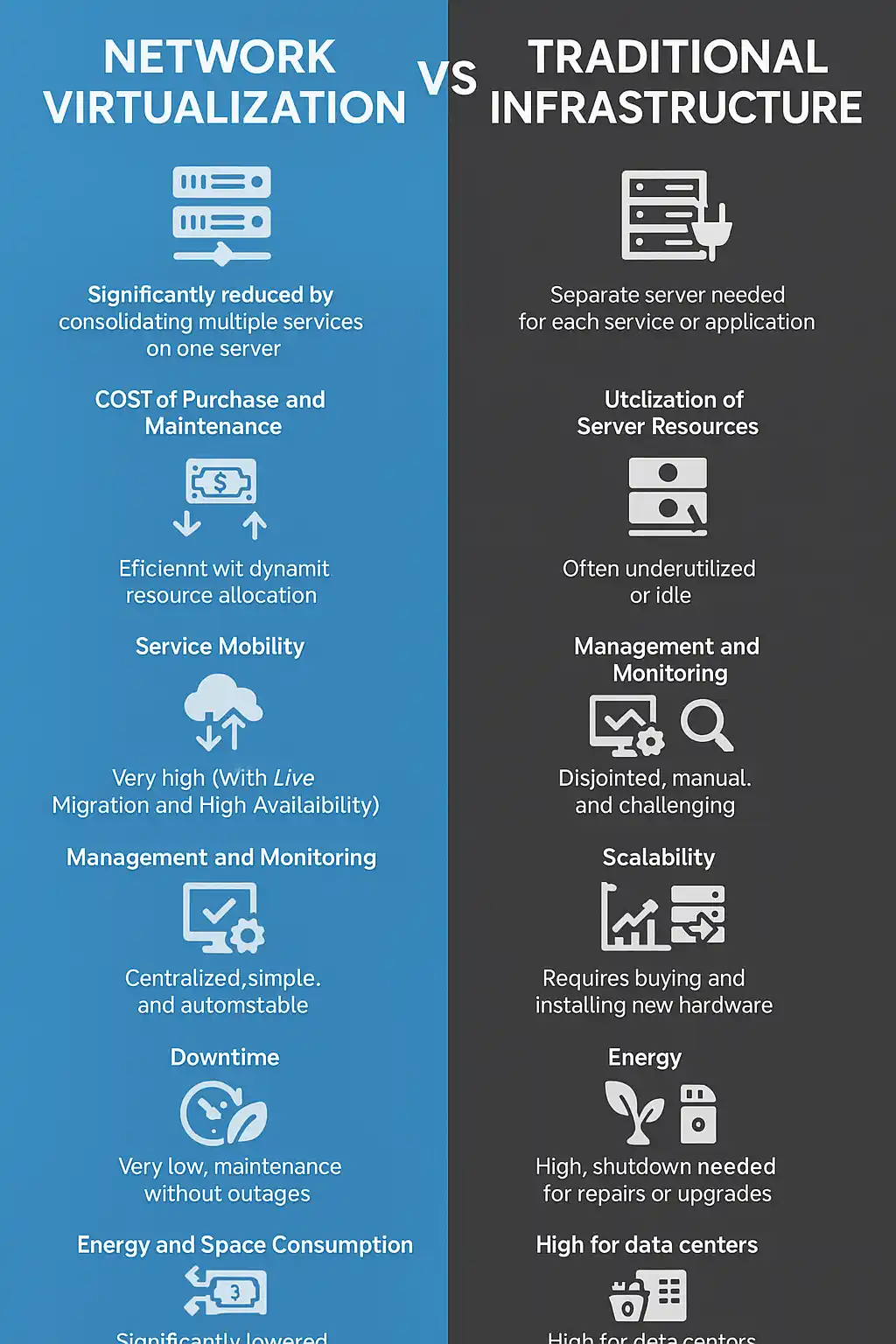
Table: Network virtualization vs traditional infrastructure
| Comparison metric | Network Virtualization | Traditional Network Infrastructure |
|---|---|---|
| Need for physical hardware | Significant reduction due to consolidation | Requires separate servers per service |
| Purchase and maintenance costs | Significant reduction | Higher due to multiple devices |
| Server resource utilization | Optimal with dynamic allocation | Resources often underutilized or over-provisioned |
| Service mobility | Very high (Live Migration and High Availability) | Limited and time-consuming |
| Management and monitoring | Centralized, simple, automatable | Distributed and human-dependent |
| Scalability | Easy and rapid with new VMs | Requires new hardware purchases |
| Downtime | Very low; maintenance without downtime possible | High; downtime needed for repairs or upgrades |
| Energy and space | Significant reduction | High energy usage in data centers |
| Network security | Ability to isolate services and apply per-VM policies | Hardware-centric security with limited flexibility |
Conclusion
Network virtualization, by reducing the need for physical servers, improving management and monitoring, automating processes, reducing downtime, and saving energy, can significantly lower the maintenance and management costs of organizational networks. This technology enables organizations to operate more efficiently and make better use of their resources.
برای ارزیابی پایداری، امنیت و نگهداری این زیرساخت، راهنمای پشتیبانی شبکه را نیز مطالعه کنید.