Principles of Server Room Design
This article outlines the principles of server room design, including site selection, cabling, cooling, safety, and key international standards such as TIA-942 and ISO/IEC 27001.
خلاصه تخصصی مقاله
This article outlines the principles of server room design, including site selection, cabling, cooling, safety, and key international standards such as TIA-942 and ISO/IEC 27001.
موضوعات اصلی: پشتیبانی شبکه، اتاق، سرور، باید، طراحی، استاندارد
Factors influencing the server room
Weather is one of the factors affecting energy consumption and environmental impact of a server room. In colder regions, the need for cooling equipment is reduced, which can lower electricity consumption. Some countries with cold climates emphasize server room design in particular locations for environmental reasons. The article then outlines key design considerations.
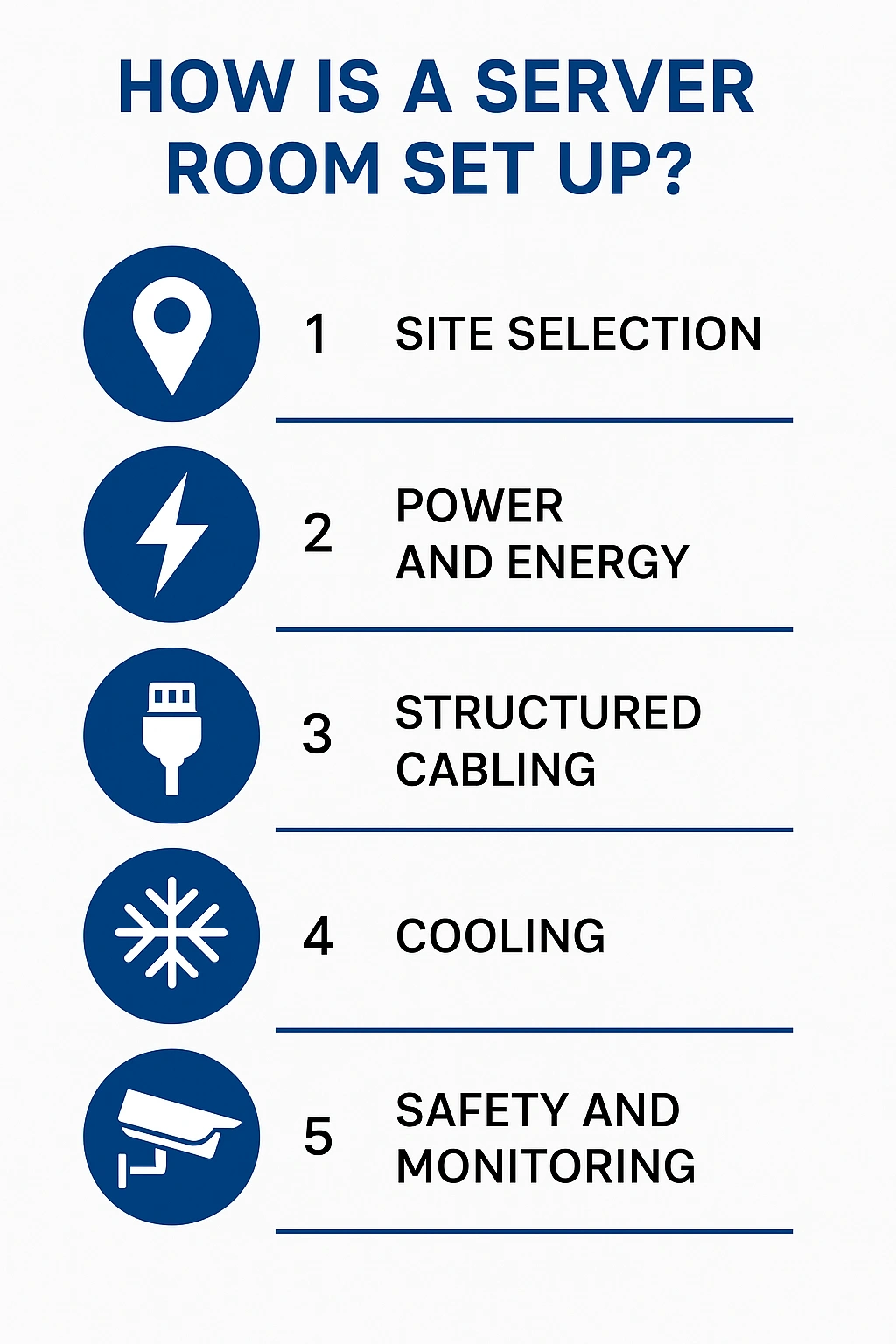
How is a server room set up?
Setting up a server room is a multi‑phase, specialized process that requires careful planning. The aim is to create a stable, secure, and reliable environment for continuous operation of servers and network equipment.
- First, a suitable location for the server room must be chosen. The space should have adequate ventilation, controlled humidity, high physical security, and limited unauthorized access.
- Next, the electrical infrastructure is designed and implemented. This includes main electrical cabling, installation of an uninterruptible power supply (UPS) for emergency power, and proper grounding for safety against surges.
- Structured network cabling is then carried out. Standard cables and network racks are used to ensure data transfer with minimal noise and maximum stability. Power and data pathways are kept separate to avoid interference.
- Subsequently, a dedicated cooling system is designed. Cooling solutions are used to keep ambient temperature within standard ranges and to vent heat generated by servers effectively.
- Finally, safety and monitoring systems are installed. This includes fire detection and suppression, CCTV monitoring, and temperature and humidity sensors to continuously monitor the room.
What are the phases of implementing a server room?
Implementation follows stages aligned with standards. Having a competent and experienced team is crucial. The process comprises several main parts.
What does upper-floor preparation mean?
Among the factors in server room setup is preparing the upper floor slab. Reasons include:
- Preventing water exposure if pipes leak
- Utilizing the space between the floor and the upper level for cabling
- Preventing electrical hazards
Proper preparation ensures safety and equipment performance. Grounding cabling aids in cable management and makes fault finding easier over time.
In normal conditions, static electricity in the environment can be discharged when people walk, which can disrupt systems. Therefore a grounding system is essential.
Why should we use suspended ceilings and false walls?
A suspended ceiling helps route cables and protects equipment from exposure. False walls are important for fire protection and thermal insulation. The space between the main wall and the false wall is typically filled with fiberglass or mineral wool as a thermal and acoustic insulator. Appropriate ventilation and maintaining standard temperatures are essential to protect electronic components. The server room is a core part of an organization and requires ongoing professional inspection and maintenance. It also requires cabling, cable trays, wiring, and related components.
Mapping and documenting server room equipment
Creating comprehensive maps and documenting all equipment is vital. Diagrams and documentation should be updated regularly and available in digital and printed formats. A complete equipment list should be maintained to address future issues efficiently.
Software documentation
Software documentation covers tools, update schedules, and assignment of maintenance responsibilities. Software resources should be readily available for quick installation when needed.
How is server room testing performed?
Before commissioning, the server room is tested: power systems are energized and checked, cooling is validated to maintain required temperatures, network cabling is tested to standards, fire alarm systems are tested, and lighting and other utilities are checked. Liquid cooling technologies can provide higher efficiency by absorbing heat in a liquid, which can then be removed with simple cooling cycles.
What does liquid cooling technology mean?
Liquid cooling enables heat recovery and can be integrated with building heating systems, allowing server heat to contribute to space heating. As organizations grow, electrical and cooling demands increase, so cooling designs must be scalable. Rack configuration is a key consideration, and standard racks can host many servers.
International standards related to server room design
Adhering to international standards is important to ensure security, reliability, and efficiency of network equipment. The main standards are TIA-942 and ISO/IEC 27001.
TIA-942 is a primary reference for data centers and server rooms, covering physical and infrastructural aspects such as physical structure, cabling, cooling, power, and physical security. Compliance with this standard supports durability and maintainability.
ISO/IEC 27001 focuses on information security and provides a framework for implementing an Information Security Management System (ISMS). Key principles include risk assessment, security policies, security controls, and continual improvement. Combining these standards helps organizations create a robust and secure environment for data.
Table comparing TIA-942 and ISO/IEC 27001
| Features | TIA-942 | ISO/IEC 27001 |
|---|---|---|
| Type | Technical Infrastructure | Information Security Management |
| Core Focus | Physical design and infrastructure of data centers and server rooms | Information security and data risk management |
| Scope | Electrical, cooling, cabling, racks, tiers | Security policies, access control, risk management, compliance |
| Primary Goal | Ensure reliability and maintainability of equipment | Protect information from intrusion, failure, and misuse |
| Issued by | Telecommunications Industry Association (TIA), USA | ISO & IEC |
| Key Elements | Structured cabling, airflow design, power redundancy, physical security | Risk assessment, security controls, auditing, continual improvement |
| Focus Level | Hardware infrastructure and physical environment | Policies, processes, and management systems |
| Executive Benefit | Increased reliability and easier maintenance | Enhanced data security and organizational compliance |
S سخن آخر
Other design steps and considerations include electrical cabling, cooling system performance, fire alarm and suppression, network cabling and equipment installation, node and rack labeling, required amperage, UPS and generator provisioning, and operational control room access. Server room setup should follow applicable standards and be conducted by professionals. Reviewing network support guidance can assist in assessing reliability, security, and maintenance of the infrastructure.
برای ارزیابی پایداری، امنیت و نگهداری این زیرساخت، راهنمای پشتیبانی شبکه را نیز مطالعه کنید.