What is Micro-Segmentation and How Does It Strengthen Data Center Network Security?
Micro-Segmentation is a security approach that extends protection from perimeter defenses to individual workloads and applications. This article explains its concepts, mechanisms, benefits, and how it differs from traditional network segmentation.
خلاصه تخصصی مقاله
Micro-Segmentation is a security approach that extends protection from perimeter defenses to individual workloads and applications. This article explains its concepts, mechanisms, benefits, and how it differs from traditional network segmentation.
موضوعات اصلی: امنیت شبکه، Micro-Segmentation، security، policies، network، traffic
Introduction
Data centers, as the operational core of modern organizations, host large volumes of critical data. This importance also makes them attractive targets for cyberattacks. In many organizations, perimeter firewalls and traditional methods are no longer sufficient, as many threats spread from within the network or via internal East-West traffic. In this context, a modern approach called Micro-Segmentation comes into play.
Micro-Segmentation reduces the attack surface by segmenting traffic at the workload level and applying security policies to each segment, enabling a Zero Trust architecture and a multi-layered security model.
In this article we explore what Micro-Segmentation is, how it works, and why it is one of the most effective methods to improve data center network security. If your organization is considering such a solution, consulting security experts can simplify decision-making and implementation.
What is Micro-Segmentation?
Micro-Segmentation is a security approach in data center networks that extends protection beyond perimeter firewalls to include servers, virtual machines, and workloads. Traditional network segmentation divided the network into large blocks, with security controls mainly at the borders; if an attacker breached one block, they could move laterally to other resources.
Micro-Segmentation removes this limitation. Each workload or application can have its own security policy, enabling granular access control at the smallest possible level.
Key Features of Micro-Segmentation
- Granular control of East-West traffic between servers and VMs is enforced and monitored.
- Workload-Level policies allow policy enforcement based on workload type or user, not just IP or VLAN.
- High flexibility supports on physical, virtual, and cloud infrastructures.
- Alignment with Zero Trust implementing the principle of no implicit trust.
Real-World Example
In a banking data center, a customer database server and a web server might share a VLAN. Traditional approaches could allow the web server direct access to the database. With Micro-Segmentation, a policy can be defined so that the web server cannot access the database directly and must communicate through a secure, controlled API instead.
How Micro-Segmentation Works
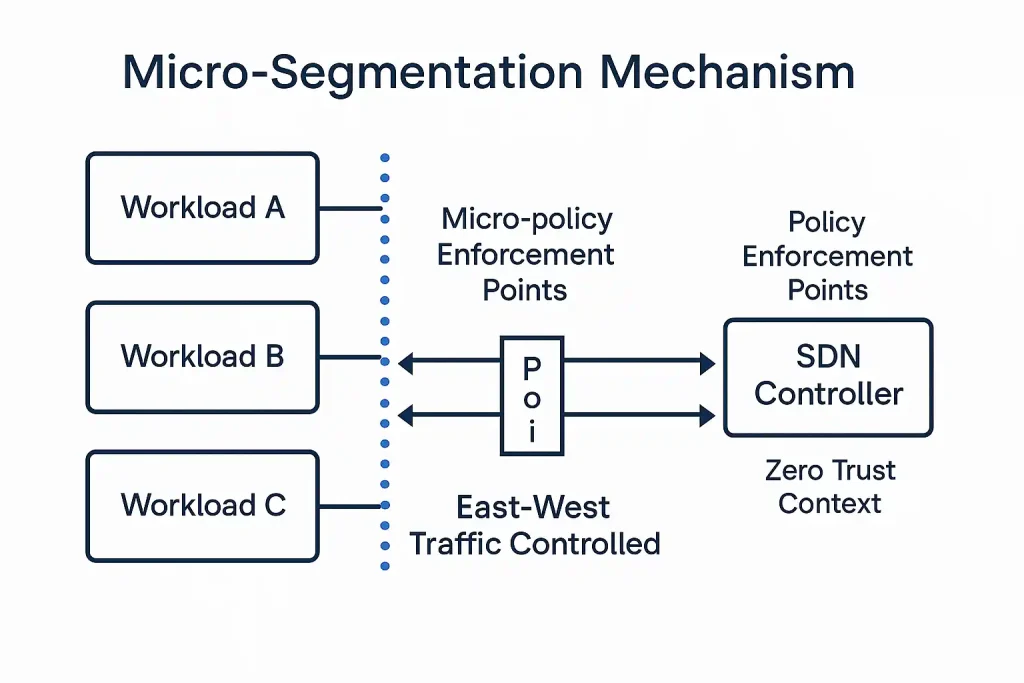
To understand how it strengthens data center security, we look at the mechanisms it uses. It combines precise security policies with software-defined networking (SDN) to move security from the network edge to the data center core.
East-West Traffic Control
Traditional networks focus on North-South traffic (user-to-datacenter). Most breaches spread laterally through East-West traffic (server-to-server). Micro-Segmentation monitors and restricts these flows precisely. For example:
- Only the Application server may access the database on a specified port.
- An infected server cannot freely access other workloads.
Workload-Level Policies
Unlike traditional segmentation centered on VLAN/Subnet, Micro-Segmentation allows per-workload or per-application policies. Examples:
- A CRM VM should interact only with an Authentication service.
- An Email Server VM should not have access to financial databases.
This granular security reduces lateral movement in case of compromise.
Using SDN
SDN technologies such as NSX or ACI form the backbone of Micro-Segmentation. These platforms allow security policies to be defined centrally and automatically propagated across the network.
- VMware NSX enables Security Groups and policy enforcement based on application tags.
- Cisco ACI controls East-West traffic using endpoint group profiles.
Thus, policy management is centralized, avoiding manual configurations on each device.
Benefits for Data Centers
- Reduced attack surface: precise workload isolation and tailored policies reduce vulnerabilities.
- Zero Trust architecture: no implicit trust; every connection is authenticated and authorized.
- Limited lateral movement: attackers cannot easily reach other servers or applications.
- Compliance with security standards: supports regulatory requirements in sensitive industries.
- Simplified policy management: manage policies at the workload or application level.
Tools and Technologies
Organizations can deploy Micro-Segmentation using a mix of software, cloud-native, and SDN-driven tools to manage policies at the workload level.
- VMware NSX
- Cisco ACI
- Illumio ASP
- Guardicore
- Cloud-Native Solutions
Challenges and Limitations
| Challenge / Limitation | Description |
|---|---|
| Complexity of policy design | Defining security rules at workload level requires careful understanding of traffic flows. |
| Need for SDN expertise | Proper implementation requires familiarity with SDN concepts and tools such as NSX or ACI. |
| Initial implementation costs | Licenses, compatible hardware, and personnel training can be significant. |
| Ongoing monitoring and management | Continuous visibility is needed to keep policies up to date and network performance stable. |
| Integration with existing infrastructure | Some legacy data centers may have incompatibilities with new approaches. |
نتیجهگیری
Micro-Segmentation امروزه به یکی از ستونهای اصلی امنیت شبکههای دیتاسنتر تبدیل شده است. این رویکرد امنیت را از مرز شبکه فراتر برده و تا سطح بارهای کاری و اپلیکیشنها گسترش میدهد، نتیجه آن کاهش قابل توجه سطح حمله، جلوگیری از حرکت جانبی مهاجمان و ایجاد معماری واقعی Zero Trust است.
با وجود چالشهایی مانند هزینه اولیه، پیچیدگی طراحی و نیاز به دانش تخصصی، مزایای امنیتی، انطباق با استانداردها و پایداری دیتاسنترها از اهمیت بالایی برخوردار است. سازمانها برای تقویت امنیت شبکه دیتاسنتر و کاهش ریسک حملات داخلی باید Micro-Segmentation را بهعنوان بخشی از نقشه راه امنیتی خود درنظر بگیرند.
تفاوت با Network Segmentation سنتی
Network Segmentation سنتی شبکه را به بخشهای بزرگ میبرد و امنیت را در مرز این بخشها تعریف میکند. در مقابل، Micro-Segmentation سطح دسترسی را تا بارها و اپلیکیشنها هم تنگتر میکند.
آیا پیادهسازی به سختافزار جدید نیاز دارد؟
خیر، اکثر راهکارها نرمافزاریاند و با استفاده از SDN روی زیرساخت موجود اجرا میشوند.
آیا Micro-Segmentation برای Cloud و Hybrid Cloud مناسب است؟
بله. نمونههای Cloud-native مانند گروههای امنیتی VPC و NSG نشاندهنده کاربرد Micro-Segmentation در محیطهای Cloud هستند.
مهمترین مزیت چیست؟
مهمترین مزیت، جلوگیری از حرکت جانبی مهاجمان در دیتاسنتر و کاهش قابل توجه سطح حمله است.
برای ارزیابی پایداری، امنیت و نگهداری این زیرساخت، راهنمای پشتیبانی شبکه را نیز مطالعه کنید.