SNMPv3 vs NetFlow and sFlow: Which monitoring protocol fits your network best?
Modern digital infrastructures require precise network monitoring. This article compares SNMPv3, NetFlow, and sFlow to help you choose the right protocol for your network needs.
خلاصه تخصصی مقاله
Modern digital infrastructures require precise network monitoring. This article compares SNMPv3, NetFlow, and sFlow to help you choose the right protocol for your network needs.
موضوعات اصلی: پشتیبانی شبکه، امنیت شبکه، مانیتورینگ شبکه، NetFlow، شبکه، sFlow
In today’s rapidly expanding digital infrastructure, precise network monitoring is a necessity. Any disruption or security threat can halt operations, making standardized monitoring protocols essential.
What are the network monitoring protocols SNMPv3, NetFlow, and sFlow?
SNMPv3, NetFlow, and sFlow are standard protocols used to collect, analyze, and monitor the status of devices and network traffic. SNMPv3 focuses on device health and performance metrics with strong security, while NetFlow and sFlow are used for traffic flow analysis and pattern identification. These protocols play a key role in managing, securing, and optimizing organizational networks, and selecting the right one depends on monitoring needs and network scale.
What is SNMPv3 and what are its features?
SNMPv3 stands for Simple Network Management Protocol version 3 and is one of the most common protocols for managing and monitoring network devices. It introduces encryption, strong authentication, and access control to enhance security.
Key features of SNMPv3
- Advanced security Encryption for data confidentiality and authentication to prevent unauthorized access.
- Centralized user management Role-based access control for monitoring devices.
- Compliance with IETF standards Alignment with RFC 3411–RFC 3418 for structural and security foundations.
- Backward compatibility Some tools support SNMPv1/v2 to ease migration.
- Reduced risk of MITM and replay with authenticated messages.
In which environments is SNMPv3 used?
SNMPv3 is suitable for networks requiring continuous, secure, and controlled monitoring:
- Organizational data centers
- Financial and banking networks
- Hospitals and critical health infrastructure
- VoIP networks and ISPs needing precise bandwidth monitoring
- Organizations with BYOD or high accessibility requirements
“SNMPv3 provides security features such as message integrity, authentication, and encryption to prevent unauthorized access and potential attacks.”
What is NetFlow and how does it work?
NetFlow is a powerful protocol for network traffic analysis, supported across a range of devices. Unlike SNMP, which focuses on device status, NetFlow provides detailed information about traffic flows, enabling precise analysis of bandwidth usage, anomaly detection, and network optimization.
How NetFlow works
NetFlow records data for each flow. A Flow typically includes source/destination IP, source/destination ports, protocol, service class, and input/output interfaces. When a new flow is identified, the device stores its information in a table and exports it to a NetFlow Collector for processing and storage.
Key NetFlow applications
- User and device behavior analysis e.g., identifying the user who consumes the most bandwidth.
- Anomaly and threat detection e.g., unusual traffic patterns to unknown destinations.
- Bandwidth management examining which services or apps consume the most resources.
- Infrastructure planning guiding upgrades based on data analysis.
Practical example
In a multi-site organization with complaints of slow Internet, NetFlow on the main router shows a system sending large volumes of data to an external address. Investigation reveals malware infection and exfiltration of organizational data. The support team can isolate and remediate the system based on NetFlow insights.
sFlow: advantages and considerations
sFlow or sampled Flow uses statistical sampling to monitor traffic. This approach makes sFlow lightweight, fast, and scalable for large networks with high traffic.
sFlow can capture data from multiple network layers (2–7) depending on configuration and supports diverse vendor equipment.
How sFlow works
- Sampled Packet Headers randomly sample portions of packets for lightweight analytics.
- Interface counters provide statistical port-level data (packets in/out, errors, rates, etc.).
The data are collected by an sFlow Collector for aggregation and analysis.
When to use sFlow
Best suited for networks with many switches, high traffic, and need for lightweight but broad visibility, such as data centers and multi-vendor environments.
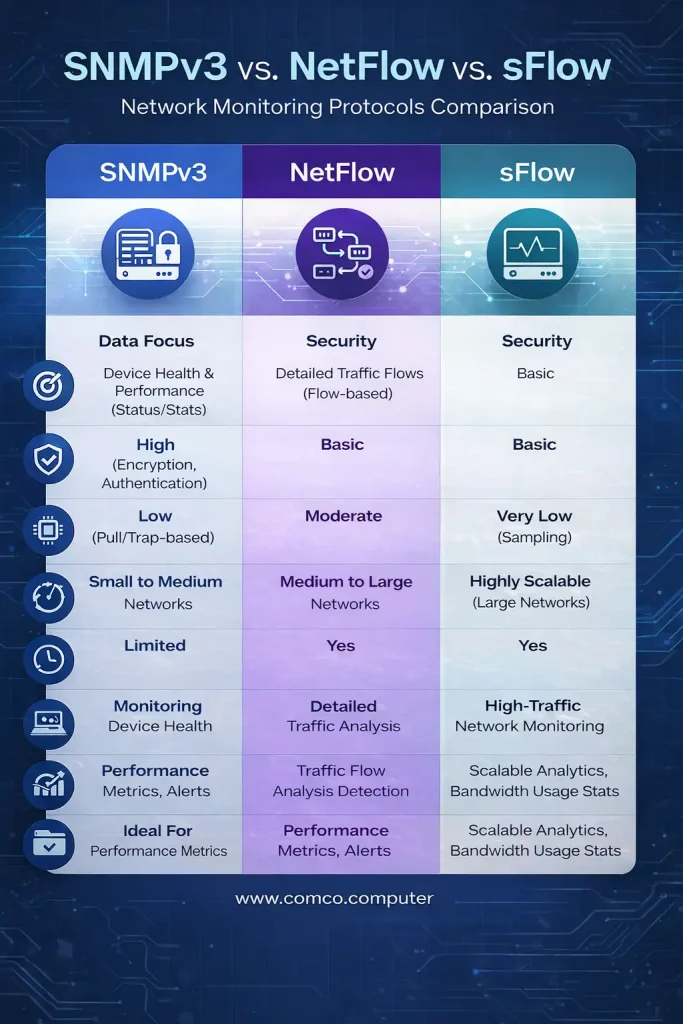
Comparison table: SNMPv3, NetFlow, and sFlow
| Features / Protocols | SNMPv3 | NetFlow | sFlow |
|---|---|---|---|
| Data type | Device health and general parameters | Precise traffic flows | Traffic sampling and port data |
| Internal security | Present (authentication, encryption, integrity) | Absent (in base versions) | Absent (security via external architecture) |
| Data delivery timing | Pull or trap | Export from edge devices | Random sampling at defined intervals |
| Analysis depth | Device-level information | Detailed traffic and user/app behavior | General network behavior with lighter detail |
| Vendor compatibility | Most network devices | More Cisco-centric and similar | Broad across vendors |
| Device resource usage | Low | Medium to high | Very low |
| Best use case | Monitoring device health | Detailed data-flow and traffic behavior | Scalable, low-overhead broad monitoring |
| Packet detail level | Counters only | Levels 3 and 4 (IP and ports) | Levels 2–7 depending on settings |
| Configuration complexity | Simple | Moderate | Simple to moderate |
| Real-time support | Limited (log-oriented) | Yes (low latency) | Yes (real-time sampling) |
“Choosing between SNMP, NetFlow, and sFlow depends on organizational needs. If security and precise device monitoring are crucial, SNMPv3 is appropriate. For detailed traffic analysis, NetFlow is useful. If lightweight, scalable monitoring is needed at scale, sFlow is often the best choice.”
برای بسیاری از پشتیبانان شبکه، انتخاب پروتکلی مناسب برای مانیتورینگ تصمیمی حیاتی است. تفاوت در دقت، سربار پردازشی، سطح تحلیلپذیری و سازگاری با تجهیزات مستقیماً بر عملکرد و امنیت شبکه اثر میگذارد. SNMPv3، NetFlow و sFlow هرکدام در موقعیتهای خاصی میتوانند گزینهای مناسب باشند؛ اما موفقیت به شناخت دقیق نیازهای شبکه بستگی دارد.
آیا میتوان SNMPv3، NetFlow و sFlow را همزمان استفاده کرد؟
بله؛ در معماریهای مدرن مانیتورینگ شبکه استفاده همزمان از SNMPv3، NetFlow و sFlow نه تنها ممکن است، بلکه در بسیاری از سازمانها بهترین رویکرد است. هر پروتکل زاویه دید متفاوتی از وضعیت شبکه ارائه میدهد و همپوشانی آنها کم است.
در طراحی اصولی، این سه پروتکل بهصورت مکمل عمل میکنند، نه جایگزین یکدیگر.
نقش هر پروتکل در معماری ترکیبی مانیتورینگ
- SNMPv3 – نظارت بر سلامت تجهیزات
- NetFlow – تحلیل دقیق جریانهای ترافیکی
- sFlow – دید کلی و سریع از الگوهای ترافیکی در مقیاس بزرگ
تمام دادهها به Collector/Analyzer مرکزی ارسال میشوند تا تصویر جامعی از وضعیت شبکه به دست آید.
تفاوت اصلی SNMPv3 با نسخههای قبلی چیست؟ SNMPv3 امنیتیتر است و قابلیتهایی مانند رمزنگاری، احراز هویت و تمامیت پیام را ارائه میدهد.
آیا میتوان از NetFlow و sFlow بهصورت همزمان در یک شبکه استفاده کرد؟ بله، در بسیاری از شبکههای بزرگ ترکیب این دو پروتکل برای پوشش جامعتر مانیتورینگ استفاده میشود.
کدام پروتکل کمترین سربار پردازشی را دارد؟ sFlow به دلیل نمونهبرداری آماری، سربار پردازشی بسیار کمتری نسبت به NetFlow دارد.
برای ارزیابی پایداری، امنیت و نگهداری این زیرساخت، راهنمای پشتیبانی شبکه را نیز مطالعه کنید.