Roadmap for Integrated ISO/IEC 27001 and ISO/IEC 42001 in an Organization
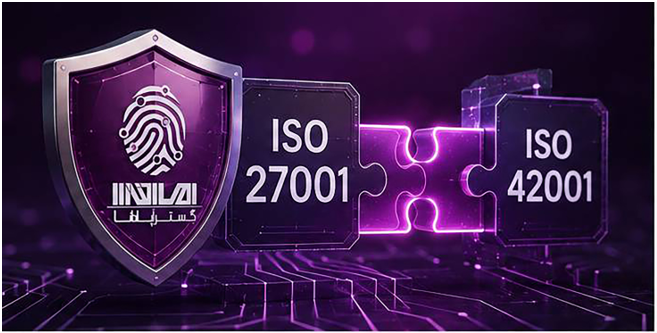
ISO 27001 provides the foundation for information security management, while ISO 42001 covers responsible and systematic AI governance. Integrating the two helps organizations manage information security risks and AI-related risks within a unified framework.
خلاصه تخصصی مقاله
ISO 27001 provides the foundation for information security management, while ISO 42001 covers responsible and systematic AI governance. Integrating the two helps organizations manage information security risks and AI-related risks within a unified framework.
موضوعات اصلی: management، security، data، risk، ISO، IEC
In recent years digital transformation has extended beyond IT infrastructure. The widespread use of artificial intelligence in organizational processes, decision support systems, customer services, data analysis, and even security solutions has redefined what we call security. Protecting information alone is no longer enough; organizations must understand
- Where do the data used by AI systems come from?
- Who has access to them?
- How are the models evaluated?
- How reliable are AI based decisions?
- In case of errors or misuse, what mechanisms exist to respond?
In this context, ISO/IEC 27001 and ISO/IEC 42001 should not be seen as two separate competing standards. ISO/IEC 27001 focuses on establishing and continually improving an information security management system, while ISO/IEC 42001 provides a framework for managing AI systems and responsible governance of AI risks and opportunities. It answers how we protect information assets and how we can ensure AI is designed and used in a controlled, responsible, and trustworthy manner. These questions are not in conflict; they often intersect.
Why is integrating these two standards important?
One common misconception is to build a separate management system for each standard with distinct policy sets, separate risk assessment processes, and duplicated forms and documents. An integrated approach reduces this complexity. Many management elements are shareable, including
- defining the organizational scope
- identifying stakeholders
- risk management
- defining responsibilities
- documentation
- training
- internal audits
- corrective actions and continual improvement
Under this model, instead of creating two parallel systems, an organization can establish a common governance and risk management framework and embed the specific requirements of each standard within that structure.
Proposed roadmap for integrating ISO/IEC 27001 and ISO/IEC 42001
Phase 1: Assess current state
The starting point should be an assessment and gap analysis. Review the status of the ISMS, sensitive assets, AI systems, policies, risk management, access controls, data security, suppliers, training and existing audits.
Phase 2: Create an integrated organizational structure
Security and AI responsibilities should be defined within a unified structure. Policy making, risk acceptance, incident monitoring, supplier management, audits and corrective actions should have clear owners.
Phase 3: Design a joint risk management framework
Develop a unified risk approach that covers both information security risks and AI lifecycle risks; address data leakage, unauthorized access, model errors, bias, untrustworthy outputs and misuse of data.
Phase 4: Integrate policies and controls
Common controls such as access management, data security, incident management, supplier management, training, change management and internal audits should sit in a single structure, with AI-specific controls added.
Phase 5: Manage the AI lifecycle
From needs assessment and risk evaluation to selection or development, data review, testing and validation, deployment, monitoring, review and retirement; clarify roles and decision criteria.
Phase 6: Training and organizational culture
Employees should know what data not to feed into AI tools, how to evaluate model outputs, and what to do in case of abnormal behavior or security incidents.
Phase 7: Auditing, monitoring and continual improvement
Effectiveness of controls, risk assessment results, corrective actions, security and AI incidents and system performance should be periodically monitored and used in management review.
Common mistakes in the integration path
- Converting a consultancy and implementation project into a documentation project; the aim is to build an effective management system, not merely to produce a document.
- Forming two separate teams for security and AI; many AI risks relate directly to data, infrastructure, access and information security.
- Ignoring the AI lifecycle; evaluating a model only at purchase or deployment is insufficient.
- Overemphasizing certification; certification is valuable, but the main goal is the real effectiveness of the management system.
- Ignoring human factors; training, accountability and organizational culture are integral to risk control.
Benefits of integration
- Unified risk methodology for security and AI risks
- Reduced duplication in management processes
- More efficient use of organizational resources
- Increased clarity of responsibilities and decision-making
- Stronger protection of data used by AI
- Greater trust from customers and stakeholders
- Improved readiness against emerging threats
- Solid foundation for responsible AI technology development
- Facilitated auditing and evaluation of management systems
- Better alignment between cybersecurity, data governance and AI governance
Navigating ISO/IEC 27001 and ISO/IEC 42001 as an integrated approach means more than placing two standards side by side. The core objective is to establish a common language for risk management in an organization that handles sensitive information and pursues broader AI adoption. ISO/IEC 27001 provides a solid base for information security, while ISO/IEC 42001 extends this governance to AI. When combined, organizations can pursue information security and AI governance within a harmonized framework.
For assessing sustainability, security and maintenance of this infrastructure, consult the network support guide.
برای ارزیابی پایداری، امنیت و نگهداری این زیرساخت، راهنمای پشتیبانی شبکه را نیز مطالعه کنید.